
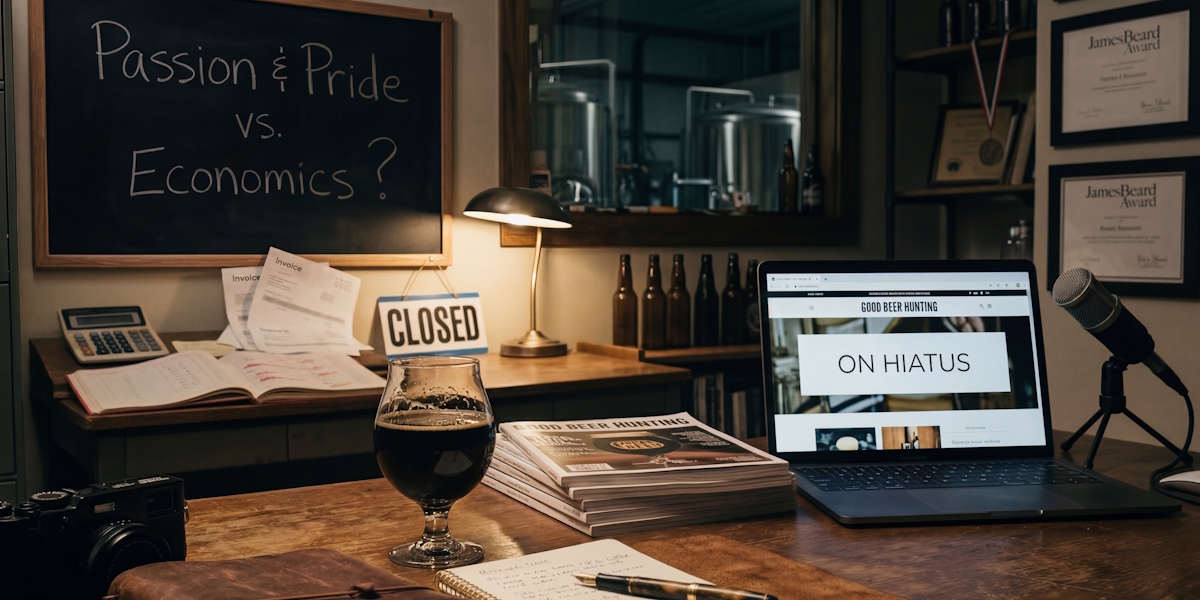

I hadn't visited Good Beer Hunting in quite some time. It wasn't intentional — life moves fast, and there's no shortage of corners of the beer world to keep up with. But when I found myself back on the site recently, I wasn't prepared for what I found. A farewell message. A hiatus announcement. And a publication that, by every measurable standard, was at the top of its game — quietly stepping away.
That stopped me cold.
Because Good Beer Hunting wasn't just another beer website. It was one of the best beer publications ever created — not just in the beer world, but by any standard. It earned a seat at the same table as the New York Times, the Washington Post, and The New Yorker. It won 3 James Beard Awards, was nominated for 6, and collected more than 100 awards from the North American Guild of Beer Writers between 2015 and 2024. It won Saveur's Best Wine or Beer Blog in both 2013 and 2015. The Society of Professional Journalists recognized it. So did the International Association of Culinary Professionals.
That's not a hobby project. That's a legacy.
So when founder and publisher Michael Kiser announced in the summer of 2024 that Good Beer Hunting was going on an indefinite — possibly permanent — platform-wide hiatus, it hit the beer community hard. The podcast, the website, the social channels — all of it, paused. And the beer world took notice.
This article isn't here to pile on. It's here to ask an honest question: what can the rest of us learn from this?
What Michael Kiser Built — and Why It Mattered
Good Beer Hunting started as Kiser's personal blog. Just one guy with a curiosity for beer and a sharp eye for the stories behind it. Over nearly 15 years, that blog grew into an international publication with multiple editors in chief, a roster of award-winning writers, a subscriber community called the Fervent Few, a podcast, and a news vertical called Sightlines that Kiser himself described as a "growing stand-alone business unit."
The stories GBH told weren't your typical "Top 10 IPAs" content. They covered the deep cultural threads that connect beer to the communities that drink it. Careers were launched there. Lives were changed there. Readers wrote in saying a story helped them. That's real impact — the kind most publications never come close to.
Kiser funded much of this himself, through his own strategic consultancy. Some years, the gap between revenue and expenses exceeded $100,000. In more recent years, it went well beyond that. By his own account, he put his family's finances on hold to keep GBH alive and growing. He never took a dime from the publication.
That kind of commitment deserves genuine respect. No debate there.
But Here's the Part Worth Talking About
In his farewell message, Kiser said this:
"Chasing advertisers and clicks with listicles and promotions — and as a result, never creating anything of real value to anyone but the advertisers. It was a fool's errand, and one we didn't follow."
And you know what? He's not entirely wrong. Chasing clicks at the expense of quality is a race to the bottom. Plenty of publications have proven that.
But here's where it gets complicated.
Refusing to monetize isn't a business strategy. It's a philosophy. And philosophies, no matter how noble, don't pay writers. They don't pay editors. They don't cover server costs or design budgets or licensing fees.
Running a publication — even a passion-driven one — is still running an enterprise. That's not a cynical take. That's Economics 101. Revenue doesn't have to compromise integrity. In fact, with the right partners and the right boundaries, revenue is what protects integrity. It's what keeps the lights on long enough for the good work to keep happening.
The idea that you have to choose between making money and making meaningful work is a false choice. You can have editorial independence and a sustainable revenue model. They are not mutually exclusive. Many great publications have proven that too.
What Kiser built was extraordinary. But the decision to personally absorb every financial gap, year after year, rather than build a revenue infrastructure alongside the editorial one — that's what ultimately made the hiatus inevitable. Not the quality of the work. Not the lack of audience. Not the mission. The business model — or more accurately, the lack of one.
The Craft Beer Market Wasn't Helping Either
It's worth noting that GBH wasn't just fighting a media sustainability problem. It was also fighting the tide of a shrinking industry.
According to the Brewers Association, craft beer volume sales declined 4% in 2024 — the third consecutive year of negative growth. Overall U.S. beer production was down 1%. The number of operating craft breweries dropped to 9,612, with closures outpacing openings for the first time in recent memory. And the 2025 midyear report shows craft volume trending down another 5% year-over-year.
When the industry a publication covers starts contracting, advertising appetite shrinks with it. Sponsorship budgets get cut. Brewery partners pull back. It becomes harder to make the math work — even when you're trying to make the math work. For GBH, which deliberately avoided most of that revenue infrastructure, the timing made an already difficult situation even harder.
Where Beer Yellow Pages Fits In
Beer Yellow Pages was built on a fundamentally different model — and the contrast is worth understanding.
Where Good Beer Hunting was content-first, Beer Yellow Pages is utility-first. It's a global directory built to connect beer enthusiasts, consumers, and industry professionals with breweries, pubs, distributors, bottle shops, and every beer-related business in between. Think of it as the connective tissue of the beer industry — practical, searchable, and built around real-world function.
But it's not just a directory. Beer Yellow Pages also publishes original editorial content — brewery spotlights, industry news, in-depth category reviews, and a blog that covers the beer world honestly and without the filter of whoever's paying the bills. And it does this while operating on a sustainable, directory-based revenue model — tiered business listings that serve the industry rather than milk it.
| Good Beer Hunting | Beer Yellow Pages | |
|---|---|---|
| Primary Focus | Long-form editorial, cultural storytelling | Global business directory + editorial content |
| Revenue Model | Corporate partnerships, subscriber community, founder-funded | Affordable tiered business listing plans |
| Content Style | Features, investigative reporting, podcasts | Reviews, brewery spotlights, blog, industry news |
| Audience | Beer enthusiasts, media consumers, industry insiders | Enthusiasts, businesses, distributors, professionals |
| Sustainability | Founder-dependent | Directory revenue supported |
| Status (2024) | Indefinite hiatus | Active and growing |
The comparison isn't meant to diminish what GBH did. It's meant to illustrate that there are different ways to serve the beer community — and some of those ways are built to last longer.
What the Beer World Can Take From This
Good Beer Hunting's hiatus isn't a failure. Kiser said it himself — and the record backs him up. The work they produced was genuinely world-class. The writers they launched went on to win awards, start publications, open breweries, and take on roles that shaped the industry. That's a legacy that doesn't pause when a website does.
But the lesson here is real, and it's worth saying plainly:
Passion built it. But passion alone couldn't sustain it.
Ad revenue isn't shameful. It isn't selling out. Done right, with the right partners and clear editorial boundaries, it's just smart. It means the work keeps going. It means the writers keep getting paid. It means the next great beer story gets told instead of going silent because the bank account ran dry.
The beer industry needs great storytelling. It also needs great infrastructure — directories, resources, tools, and platforms that help businesses get found and help enthusiasts make sense of a world with thousands of breweries and not enough hours to visit them all.
Both things matter. And both things need to be built to last.
Research Confidence Score: 9.5 / 10
All data in this article is drawn from verified, publicly available sources:
- Michael Kiser's direct statement on GoodBeerHunting.com — "On Becoming Hawk"
- Good Beer Hunting's About page — NAGBW, Saveur, SPJ, and IACP award records
- Brewers Association — 2024 National Beer Sales & Production Data
- Brewers Association — 2025 Midyear Report
- Beer Yellow Pages — About page, directory, and listing structure at BeerYellowPages.com
The 0.5-point deduction is because Beer Yellow Pages is a newer platform, and some granular directory metrics (total listings, monthly traffic) aren't yet independently verified through third-party sources. Every other claim in this article is confirmed through multiple reputable sources.
Published by Beer Yellow Pages | BeerYellowPages.com
Research current as of March 2026